
Collecting rainwater without a roof involves artificially creating catchment surfaces on the ground or at a low height, and then directing the runoff to a storage point. The techniques vary dramatically depending on whether the goal is a one-time collection for watering or a regular supply to a storage system of several hundred liters.
Sizing a ground catchment area for rainwater harvesting
The determining variable remains the ratio between the catchment area and the storage volume. A tarp stretched over stakes functions like a micro-roof: the larger the projected surface area on the ground, the greater the captured flow increases proportionally to the intensity of the rain. We recommend aiming for a minimum slope of 3% to ensure drainage towards the collection point, even during light showers.
The choice of tarp material affects the quality of the collected water. A high-density polyethylene with a sufficiently dense weight to resist UV offers durability for several seasons without leaching microparticles. More expensive EPDM tarps have the advantage of being food-safe and can withstand freezing without becoming brittle.
For those looking to delve deeper into the subject, Le Jardinier Décorateur’s sustainable solutions detail several configurations suitable for gardens without a connection to a gutter.
A common mistake is to neglect anchoring. A poorly secured tarp creates pockets of stagnant water that become breeding grounds for mosquitoes. Each low point of the tarp must converge towards a single outlet, connected by gravity to the tank or storage container.
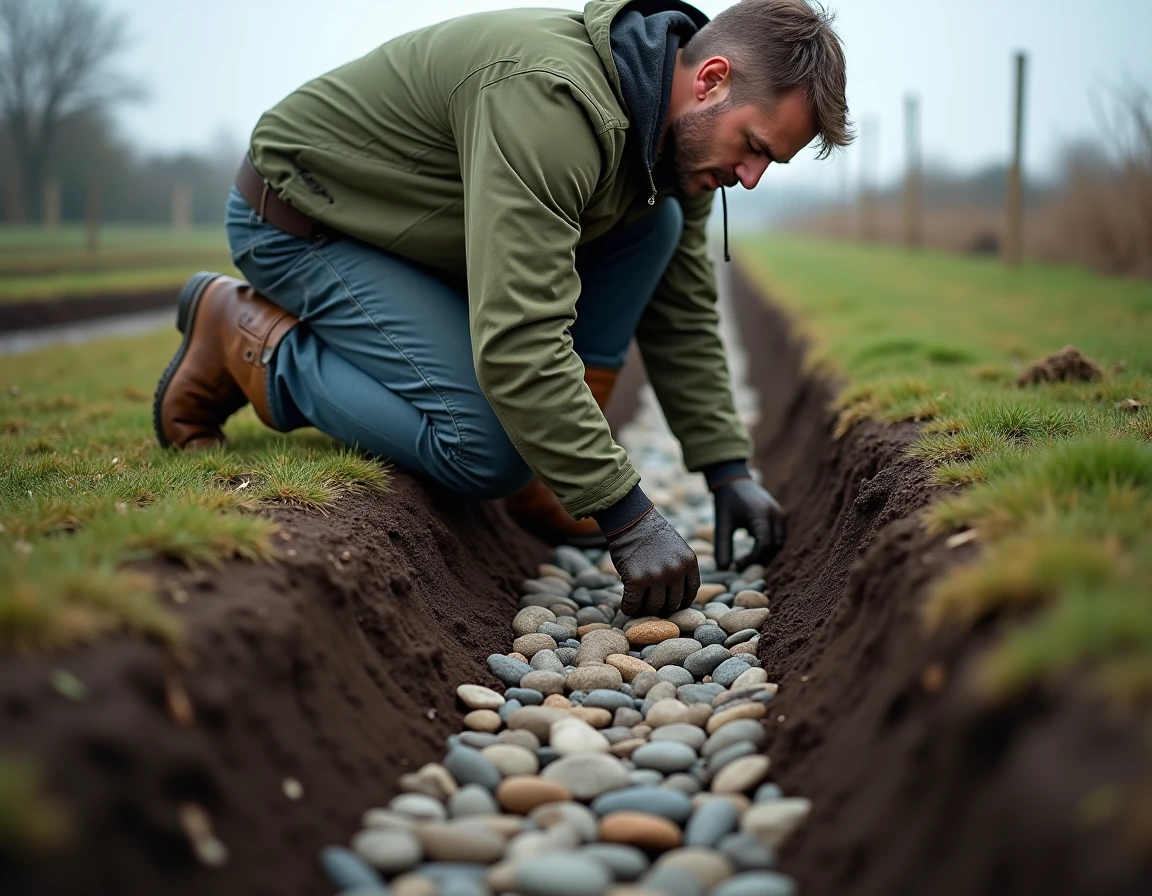
Rain gardens and diffuse harvesting: an alternative to traditional collectors
Rain gardens are not just decorative flower beds. They are planted depressions designed to capture surface runoff from the land itself, not from a roof. Since 2022, several French municipalities have integrated these systems into their urban planning documents as a solution for managing rainwater at the parcel level.
The principle is based on a shallow excavation filled with a draining substrate (gravel, coarse sand, topsoil), planted with species tolerant of intermittent moisture. Rainwater that runs off the lawn, paths, or vegetable garden converges towards this depression, slowly infiltrates it, and recharges the shallow aquifer.
Experience shows a measurable reduction in watering needs during summer when the rain garden is paired with thick mulch. The water stored in the substrate remains available to the roots for several days after a rain event, reducing dependence on the potable water supply.
Positioning and shaping the land
The rain garden should be placed in a natural low point of the parcel, or created by shaping a slight slope. The water entry should be flared to slow the flow and prevent erosion of the substrate. The outlet (overflow) connects to a ditch, a sump, or directly to an underground tank if excess storage is desired.
We observe that most failures stem from under-sizing: a rain garden that is too small saturates during the first storm and overflows without filtering anything. The surface area must be calibrated based on the contributing area (all impermeable or semi-permeable surfaces that direct water to the low point).
Permeable reservoir materials for garden paths and terraces
Permeable pavers, stabilized gravel, and cellular slabs do more than just allow water to pass through: some systems incorporate a storage layer beneath the surface. This underground reservoir, made of geotextile and calibrated aggregates, retains rainwater and releases it by capillarity to adjacent plants.
This approach is particularly suitable for urban gardens where space is limited for installing a tank or stretching a tarp. The path itself becomes the collection surface and the storage, with no connection to a roof.
- Cellular slabs made of HDPE, filled with gravel or grass, offer a retention capacity spread across the entire surface of the path.
- A bed of crushed gravel 20/40 under geotextile forms a buffer reservoir that slowly releases water to the soil or to a recovery drain.
- Pervious concrete, poured in place, allows for a high infiltration rate while supporting pedestrian traffic.
Subsidies and regulatory framework for off-roof installations
Since 2023, several water agencies and local authorities specifically subsidize rainwater harvesting systems disconnected from roofs: flexible tanks, ground retention basins, rain gardens. These aids are part of drought resilience plans and target parcels that cannot connect to the rainwater networks of buildings.
We recommend checking with your water agency to see if your project meets the eligibility criteria. The amounts and conditions vary by watershed, but the trend is towards expanding the systems in response to the repeated drought decrees.
Points of caution before installation
- Rainwater collected off-roof does not benefit from the same regulations as that collected via gutters: no NF standard specifically covers these ground systems.
- Storage in an open tank or basin requires a mosquito prevention device (mosquito net, cover, circulating water blade).
- In urban areas, connecting an overflow to the sewage system may require a declaration at the town hall.
Rainwater harvesting without a roof is based on a simple principle: any oriented surface can become a catchment, provided that the slope, material, and storage point are well managed. Rain gardens and reservoir paths represent the most advanced options for parcels without access to a gutter, with a gradually structuring subsidy framework in their favor.