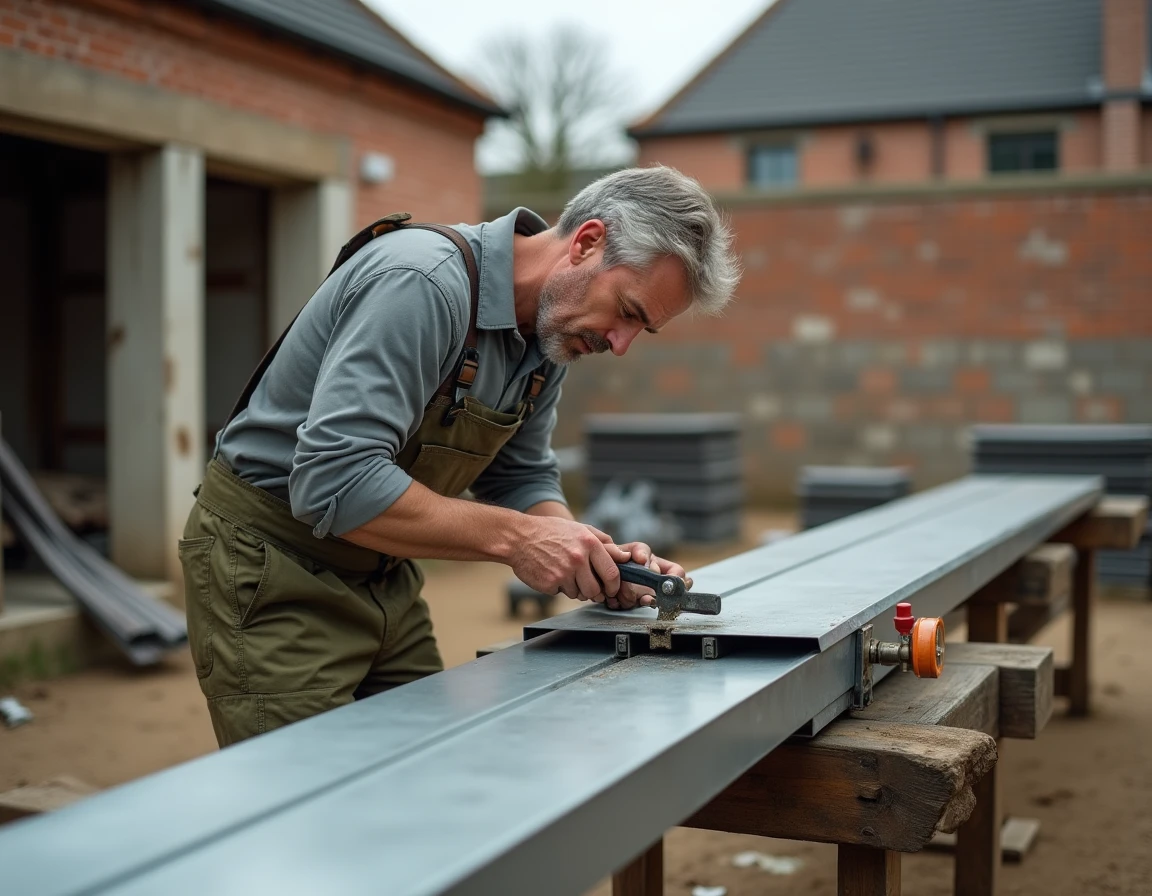
Cutting a zinc gutter seems simple until the shears slip and the edge twists. Zinc is a material that is both flexible and brittle, making the cutting of zinc gutters delicate, especially when it comes to fitting a section near a bend or an already installed joint.
The difficulty does not lie in the hardness of the metal. It comes from its tendency to deform under uneven pressure, which then compromises the fitting between the elements.
Cutting a zinc gutter near a joint: the gesture that changes everything
You may have noticed that a section cut in the workshop fits easily, while an adjustment on a renovation site often ends up with a wavy edge? The reason lies in how the piece is held. When the gutter is already fixed to the brackets, or when a bend limits access, the piece vibrates under the tool and the profile deforms.
To work near a piece that is already installed, you need to secure the section on both sides of the cutting line. A pair of flat pliers, placed a few centimeters from the line, prevents the zinc from bending during shearing. This firm hold is the difference between a clean edge and a burr that will need to be filed down.
When cutting near a joint or a fitting, proceed with small advances rather than making a clean cut in one go. The tool should move slowly, biting a few centimeters at a time. This approach avoids exerting leverage on the remaining part, which would pull the profile down.
If you are looking to understand the steps to cut a zinc gutter in a vertical downspout context, the principle remains the same: stabilize, then advance gradually.
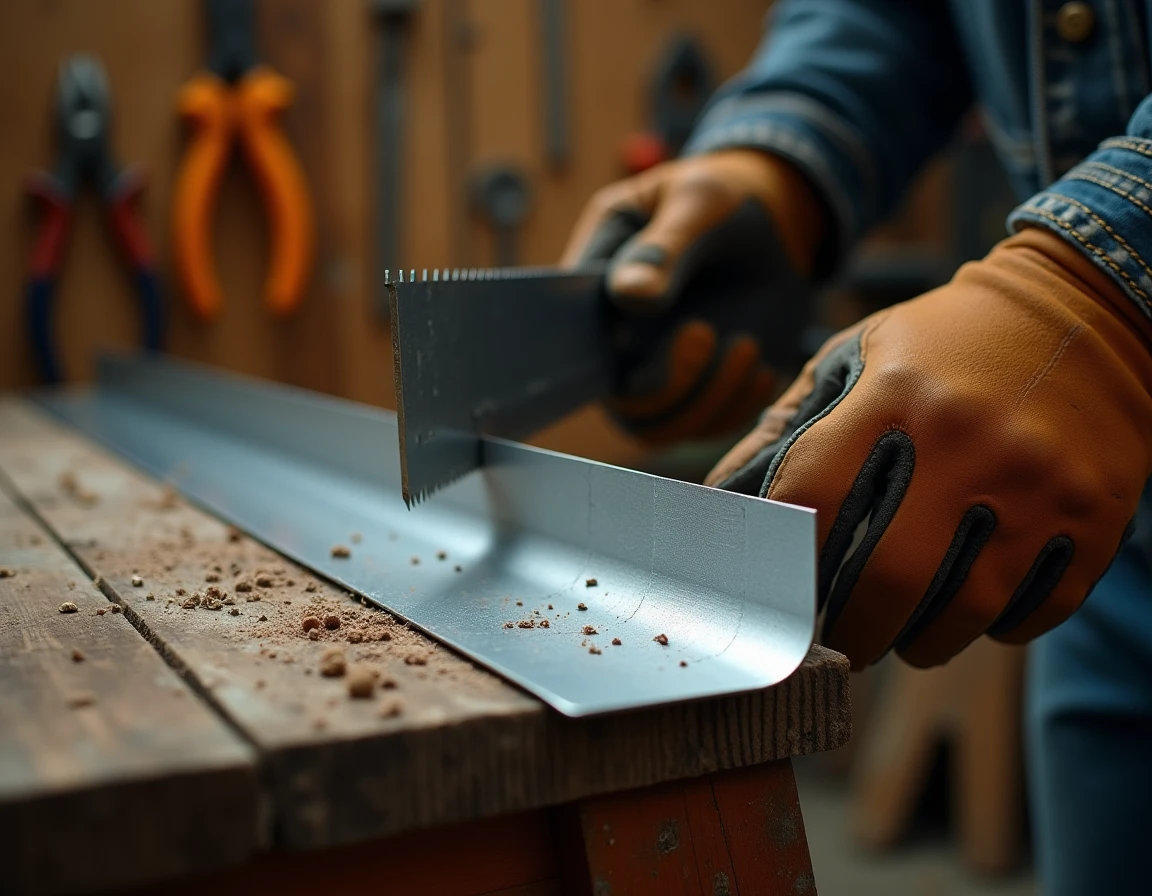
Tools for cutting zinc: choose according to the geometry of the piece
A half-round gutter profile is not cut with the same tool as a downspout or a flat sheet of zinc. The geometry of the piece dictates the choice of tool, not the other way around.
Shears and zinc worker’s claw for straight cuts
For a straight line on a developed gutter, the zinc worker’s claw provides the cleanest line. You score the surface along its entire length, then gently bend the zinc along the line to achieve a clean break, without burrs. This technique works well on commonly thick zinc.
The universal shears are also suitable for straight cuts, provided you do not force them. Dull shears crush the edge instead of cutting it.
Pelican shears and nibblers for curved cuts
To follow a curve (such as adapting around a bend), the pelican shears offer a tighter cutting radius. Its lower blade, which is wider, passes under the sheet without lifting it.
The electric nibbler cuts without deforming the profile, as it removes a thin chip of metal rather than shearing. It is particularly useful on circular downspouts, where any lateral pressure would ovalize the tube.
- Straight cut on an open gutter: zinc worker’s claw or well-sharpened universal shears
- Curved cut or adjustment around a bend: pelican shears for precise manual control
- Cut on a tubular downspout: nibbler to avoid ovalizing the tube
Why to avoid using a grinder to cut a zinc gutter
The angle grinder is often the first reflex on a construction site. On zinc, this is a bad idea for three concrete reasons.
The abrasive disc heats the cutting edge. This heat alters the protective patina layer of the zinc and accelerates oxidation at the exact point where two elements will fit together. The joint between two sections then becomes a weak point.
The rotation speed projects hot particles onto adjacent surfaces. On a gutter being installed, these projections mark the zinc visible from the ground.
The third problem is precision. A grinder disc removes more material than shears, making it difficult to achieve a millimeter-perfect fit. For a joint by fitting, every lost millimeter compromises the sealing of the assembly.

Finishing the edge after cutting zinc
A rough cutting edge, even if clean, often has slight burrs or a sharp edge. These imperfections hinder fitting and can cause injury during handling.
Run a fine flat file along the cut edge, always pulling in the same direction (no back and forth). This action removes micro-burrs without rounding the profile. On a downspout, a fine sandpaper wrapped around your finger can smooth the inside of the edge.
- Fine flat file for straight gutter edges
- Fine sandpaper for the inside of downspout tubes
- Check the fit before welding or final installation
Always check the fit before securing anything. Slide the cut section into the joint or fitting without forcing. If it resists, it means a burr remains or the cut has slightly deformed the profile. It is better to take the file again than to force the assembly.
On a renovation site, this check avoids having to dismantle an already welded or glued element. Zinc does not tolerate multiple adjustments in the same spot well, as each handling weakens the patina and the metal itself. A careful cut from the start remains the best guarantee of a durable and watertight assembly.